What Is Tesla V2L? How Vehicle-to-Load Works and Why It Matters
Tesla owners often wonder: What is Tesla V2L, and can a Tesla really power external devices? V2L (Vehicle-to-Load) allows an electric vehicle to use energy stored in its battery to power external equipment such as camping gear, small appliances, tools, and emergency devices. Unlike regular EV charging, V2L turns your Tesla into a mobile power source when you need electricity away from home.
For Tesla owners who enjoy road trips, outdoor adventures, or simply want more flexibility from their vehicle, understanding how Tesla V2L works, which models support it, and what solutions are available is the first step to unlocking more possibilities from your Tesla.

What Is Tesla V2L?
Tesla V2L stands for Tesla Vehicle-to-Load, a technology that allows a Tesla vehicle to send stored battery power to external devices instead of only using energy for driving.
In simple terms, V2L lets your Tesla work like a high-capacity portable power station. Instead of carrying a separate battery generator, compatible Tesla owners can use vehicle energy to run everyday electronics, outdoor equipment, and essential devices during travel or emergencies.
Traditional EV charging only moves electricity into the vehicle battery. V2L adds the ability to move energy out of the vehicle battery, creating new use cases for Tesla owners who want more utility from their EV.
How Tesla V2L Is Different From Regular EV Charging
When charging a Tesla, electricity flows from an external power source into the vehicle battery. V2L works in the opposite direction by allowing stored battery energy to power external loads.
For Tesla owners, this means the vehicle can provide power for situations such as:
- Running a portable refrigerator during camping trips
- Charging laptops and mobile devices while traveling
- Powering lights and small tools at outdoor locations
- Providing temporary power during short emergencies
Tesla’s approach to V2L depends on the vehicle model and hardware configuration. Some Tesla vehicles use integrated power outlets, while others require a compatible outlet adapter solution to access external power output.
Understanding these differences helps Tesla owners choose the right power solution based on their vehicle and intended use.

How Does Tesla V2L Work?
Tesla V2L works by allowing energy stored in the vehicle’s high-voltage battery to flow outward and power external devices. Instead of only receiving electricity from the grid, a compatible Tesla can act as a mobile energy source for equipment such as camping appliances, tools, lights, and electronic devices.
The exact way V2L works depends on the Tesla model and available hardware. Some Tesla vehicles use built-in power outlets, while other compatible models require an outlet adapter solution to access external power output. Understanding this difference helps owners choose the right setup for their driving and lifestyle needs.
How Tesla V2L Converts Battery Power Into Usable Electricity
A Tesla battery stores energy as high-voltage DC power, while most household devices require standard AC power. A V2L system uses power conversion hardware to transform the vehicle’s stored energy into usable electricity for external devices.
When activated, the system manages power output from the vehicle battery and delivers electricity through a compatible outlet or adapter. For Tesla owners, this creates a convenient way to use the vehicle’s large battery capacity beyond transportation.
Whether you are powering a campsite refrigerator, charging electronics during a road trip, or running small outdoor equipment, Tesla V2L provides additional flexibility without carrying a separate portable power station.
Tesla V2L vs Traditional EV Charging
The main difference between regular EV charging and V2L is the direction of energy flow.
Traditional charging moves electricity from an external source into the Tesla battery. V2L allows electricity to move from the vehicle battery to external devices, turning the vehicle into a temporary power source.
For Tesla owners, this means the vehicle can support more real-world situations beyond driving, especially for outdoor activities, emergency preparation, and mobile work scenarios.
However, V2L is designed to power individual devices and appliances. It is different from more advanced bidirectional charging functions such as V2H (Vehicle-to-Home), which requires additional equipment to supply power to a home's electrical system.
Tesla V2L vs Tesla Powershare: What's the Difference?
Tesla V2L and Tesla Powershare are closely related concepts, but they are not exactly the same. V2L describes the ability to use a Tesla’s battery to power external devices, while Powershare is Tesla’s broader bidirectional power system that includes functions such as powering appliances and, in some cases, home backup solutions.
For most Tesla owners interested in camping, road trips, or mobile power, the key question is not only what the technology is called, but how to access usable power from their specific Tesla model.
Tesla V2L: Portable Power for Devices and Equipment
Tesla V2L focuses on powering external electrical devices directly from the vehicle. It allows compatible Tesla vehicles to provide electricity for items such as camping refrigerators, lights, laptops, cooking equipment, and small tools.
For Tesla owners, V2L is mainly designed for flexible outdoor and mobile power needs. Instead of carrying a separate generator or portable battery station, the vehicle’s large battery capacity can become an additional power source when properly equipped.
Depending on the Tesla model, V2L access may come through built-in outlets or a compatible outlet adapter solution. For example, newer Tesla models with supported hardware can use an adapter-based setup to provide external AC power output.
Tesla Powershare: A Broader Bidirectional Charging System
Tesla Powershare is Tesla’s name for a broader energy-sharing system that allows compatible vehicles to send power outward. It can include V2L functions as well as more advanced applications such as Vehicle-to-Home (V2H), where a vehicle can support a home electrical system with the required equipment.
The main difference is the scope:
| Feature | Tesla V2L | Tesla Powershare |
|---|---|---|
| Main purpose | Power external devices and appliances | Tesla’s broader energy-sharing system |
| Typical use cases | Camping, outdoor equipment, mobile work, emergency devices | Device power, home backup, future energy applications |
| Equipment needed | Compatible vehicle hardware and power output solution | Vehicle + compatible Powershare equipment |
| Best for | Everyday portable power needs | More advanced energy management |
For Tesla owners looking to add practical power capability to their vehicle, understanding the difference between V2L and Powershare helps determine which solution fits their lifestyle and Tesla configuration.
Which Tesla Models Support V2L?
Tesla V2L availability depends on the vehicle model and hardware configuration. Some newer Tesla vehicles support power output through Tesla’s Outlet Adapter, while others require additional compatibility checks. For detailed compatibility information, see the complete Tesla V2L compatibility guide.
| Tesla Model | V2L Support | Power Output Method |
|---|---|---|
| Cybertruck | Supported | Built-in power outlets or Tesla Outlet Adapter |
| Model Y Performance (newer versions) | Supported | Tesla Outlet Adapter + Gen 3 Mobile Connector |
| Model Y Premium (selected vehicles) | Supported | Tesla Outlet Adapter + Gen 3 Mobile Connector |
| Model Y Standard / older Model Y | Limited or not supported | Check vehicle compatibility before choosing a solution |
| Model 3 / Model S / Model X | No factory V2L support | Compatibility depends on available aftermarket solutions |
What Can Tesla V2L Power?
One of the biggest benefits of Tesla V2L is that it expands how owners can use their vehicle beyond transportation. By accessing energy stored in the high-voltage battery, a compatible Tesla can provide power for outdoor activities, travel, mobile work, and emergency situations.
For most Tesla owners, the goal of V2L is not to replace a home power system, but to have a convenient energy source available whenever traditional power is unavailable or inconvenient.
Tesla V2L for Camping and Outdoor Adventures
Camping is one of the most common use cases for Tesla V2L. Instead of relying only on portable battery stations or gas-powered generators, Tesla owners can use their vehicle’s battery capacity to support essential camping equipment.
With a compatible V2L setup, Tesla owners can power devices such as:
- Portable refrigerators and coolers
- Camping lights and lanterns
- Electric cooking equipment
- Fans and small heaters
- Cameras, laptops, and other electronics
For Tesla owners who frequently travel, V2L can make road trips and outdoor adventures more comfortable by providing convenient access to electricity without carrying multiple separate power devices.
Read More: Tesla V2L: Empower Your Camping Experience with Tesla's Vehicle-to-Load (V2L) Technology
Tesla V2L for Emergency Power
A Tesla battery stores significantly more energy than most portable power banks, making V2L useful for temporary backup situations.
During short-term power interruptions or when traveling in remote areas, compatible Tesla vehicles can help power essential devices such as:
- Communication equipment
- Mobile phones and laptops
- Small medical electronics
- Emergency lighting
However, V2L is designed for individual devices and small appliances rather than replacing a full home backup system. More advanced functions such as Vehicle-to-Home (V2H) require additional hardware and a compatible energy management setup.
Read More: Tesla V2L Guide: How to Use It for Camping, Emergency, and Daily Life
Tesla V2L for Mobile Work and Daily Use
For Tesla owners who use their vehicle as a mobile workspace, V2L adds another layer of flexibility.
Whether working from a campsite, a construction location, or a remote outdoor area, a compatible Tesla power solution can support devices such as laptops, monitors, chargers, and small tools.
This is especially useful for owners who already rely on their Tesla for travel or business activities and want to reduce dependence on external power sources.
Read More: Create a Mobile Workspace with Tesla V2L Power Support
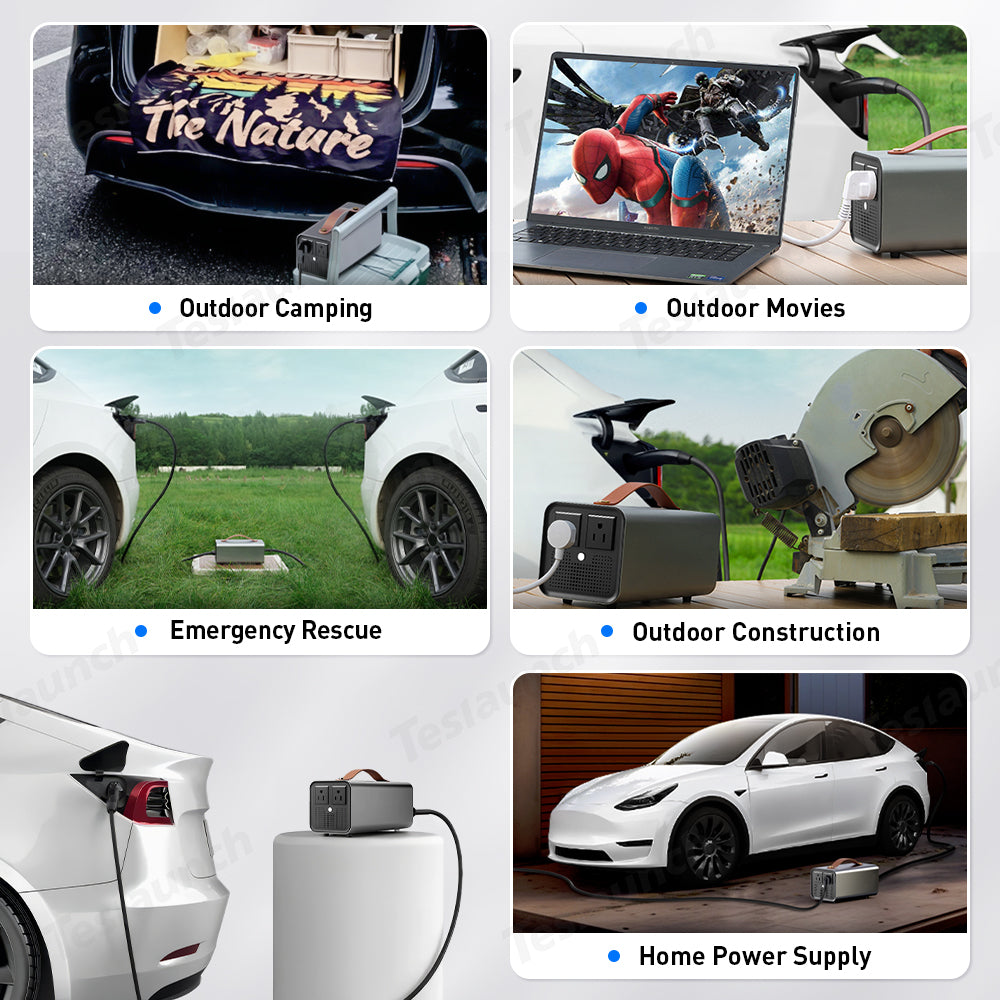
Tesla V2L Adapter: A Solution for Compatible Tesla Models
For Tesla owners whose vehicles do not include built-in external power outlets, a compatible Tesla V2L adapter can provide a practical way to access mobile power capabilities. Instead of carrying a separate portable power station, owners can use their vehicle’s battery energy to power selected devices during camping trips, road travel, outdoor work, and emergency situations.
The right adapter solution depends on your Tesla model, charging hardware, region, and intended use. Since Tesla vehicles use different charging standards and regional specifications, V2L adapters are available in different versions, including North American, European, and Australian models. Tesla owners should select the adapter version that matches their vehicle’s region and charging configuration for proper compatibility.
How a Tesla V2L Adapter Works
A Tesla V2L adapter provides a connection between the vehicle’s power system and external electrical devices. For compatible Tesla models, the adapter allows available battery energy to be converted into usable AC power for devices such as refrigerators, lights, laptops, and small appliances.
Unlike a traditional portable battery station, a Tesla V2L adapter uses the vehicle’s existing battery capacity, allowing owners to take advantage of the large energy storage already built into their Tesla.
For example, during a weekend camping trip, a Tesla owner can use a V2L adapter to support essential equipment without adding another large power device to the vehicle’s cargo space.
Why Tesla Owners Choose a V2L Adapter
Many Tesla owners enjoy the efficiency and range of their EV but still need a convenient way to access power away from home. A V2L adapter helps address common situations where charging access is limited.
Typical use cases include:
- Keeping a portable refrigerator running during road trips
- Powering camping lights and outdoor equipment
- Charging personal electronics while traveling
- Supporting mobile work setups in remote locations
For Model 3, Model Y, Model S, and Model X owners, choosing a properly matched V2L adapter can add another layer of flexibility to the Tesla ownership experience.
What to Check Before Buying a Tesla V2L Adapter
Not every Tesla vehicle has the same power output capability. Compatibility can vary depending on the vehicle model, production hardware, software support, and regional specifications.
Before selecting a Tesla V2L adapter, check:
- Tesla model and production year
- Charging connector type and region
- Required power output
- Intended devices and usage scenarios
A well-matched adapter solution helps Tesla owners safely expand their vehicle’s capabilities while avoiding compatibility issues.

Tesla V2L Limitations and Things to Know
While Tesla V2L adds valuable flexibility for outdoor power and mobile use, it is important to understand its limitations before choosing a power solution. V2L availability is not universal across all Tesla vehicles, and the available power output depends on the vehicle hardware, supported accessories, and regional specifications.
Knowing these factors helps Tesla owners avoid compatibility issues and choose a solution that matches their vehicle and intended use.
Tesla V2L Compatibility Depends on Vehicle Hardware
One of the most common misunderstandings about Tesla V2L is assuming that every Tesla with a large battery can automatically export power. In reality, V2L requires specific power conversion hardware and software support to manage energy flow from the vehicle battery.
For example, newer Tesla models with supported hardware can use compatible outlet adapters, while many older Tesla vehicles may not support factory V2L functionality. Before purchasing any V2L solution, owners should verify their vehicle model, production configuration, and adapter compatibility.
Tesla V2L Is Designed for Devices, Not Whole-Home Backup
Tesla V2L is mainly designed to power individual devices and small appliances, making it useful for camping, travel, outdoor work, and temporary power needs.
It is different from Vehicle-to-Home (V2H), which requires additional bidirectional charging equipment and a connection to a home electrical system. V2H systems involve dedicated hardware such as bidirectional chargers, inverters, and safety controls to manage power flow between the vehicle and the home.
For most Tesla owners, V2L provides a simple way to access mobile power without installing complex home energy equipment.
Power Output and Usage Considerations
The amount of power available through Tesla V2L depends on the vehicle and power solution being used. Different devices also have different power requirements, so owners should check the wattage of connected equipment before use.
For example:
- Small electronics such as phones and laptops require relatively low power.
- Camping refrigerators, lights, and cooking equipment require higher continuous output.
- Large household appliances may exceed the recommended capacity of a V2L setup.
Using V2L within the supported power range helps maintain safe and reliable operation while making the most of your Tesla’s available energy.
Future of Tesla Bidirectional Charging
Tesla V2L is an important step toward a future where EVs can become more than transportation tools. As battery technology and power management systems continue to improve, Tesla vehicles may gain broader energy-sharing capabilities, allowing owners to use their vehicles as flexible energy resources.
For Tesla owners today, V2L focuses mainly on powering external devices and equipment. Future developments in bidirectional charging may expand these capabilities toward more advanced applications, including home energy support and grid interaction.
From Tesla V2L to Vehicle-to-Home (V2H)
V2L is only one part of the broader bidirectional charging ecosystem. While V2L allows a vehicle to power individual devices, V2H (Vehicle-to-Home) enables a compatible EV to supply electricity to a home through dedicated charging equipment and energy management systems.
For example, V2H could help provide backup power during extended outages by using energy stored in an EV battery. However, this requires additional hardware, installation, and vehicle support beyond a simple V2L adapter setup.
For most Tesla owners, V2L remains the more accessible solution because it focuses on practical daily needs such as camping, travel, outdoor work, and temporary device power.
The Future of Tesla Energy Sharing
As Tesla continues developing bidirectional charging technology, more Tesla models may gain expanded energy-sharing features. Recent V2L support on newer Tesla vehicles shows a growing focus on making EV batteries more useful beyond driving.
For current Tesla owners, the best approach is to choose a power solution based on the capabilities of their specific vehicle. Whether using a factory-supported system or a compatible Tesla V2L adapter, the goal remains the same: making the vehicle more versatile for real-world situations.