Why Starlink Mini Isn't Truly Portable Without a Battery Stand (2026 Guide)
Starlink Mini is often marketed as a portable satellite internet solution.
Smaller hardware, lighter weight, easier transport.
However, in real-world use, many users quickly discover a gap between the concept of being portable in theory and its practical application.
This 2026 guide explains why Starlink Mini is not truly portable without a battery power stand, using real power data, off-grid runtime logic, and neutral comparisons.

1. What "Portable" Actually Means for Starlink Mini
When users search for "Starlink Mini portable", they are rarely asking about size alone.
They usually want to know:
- Can it work without wall power?
- Can it stay online for hours, not minutes?
- Can it be deployed quickly and reliably in outdoor environments?
- Does it adapt to changing environments?
True portability means energy independence + stable placement.
Without those two elements, portability breaks down fast.
2. Official Power Requirements: Why Power Is the First Limitation
Starlink Mini Power Demand (Official Data)
According to Starlink's published specifications and real user measurements:
- Typical operating draw: ~20–40 W
- Peak draw during startup or signal acquisition can briefly increase, but real-world measurements typically stay below ~60W.
- Starlink Mini does not consume 100W continuously, but it requires a 100W-rated USB-C PD source to ensure stable operation.
This matters because:
- Most consumer power banks cannot sustain this output
- Voltage drops cause disconnects or reboots
- "Works for a few minutes" ≠ portable internet
This is why searches like
The "Best power bank for Starlink Mini off-grid" continues to gain popularity.

3. Real-World Runtime: What Users Experience Off-Grid
Theoretical vs Practical Runtime
Battery capacity is often advertised in mAh, which can be misleading.
Example:
A 45,000mAh battery ≈ 160–170Wh (depending on cell voltage and efficiency)
At an average Starlink Mini draw of ~20–40W:
- Expected runtime: 4–8 hours
- With power optimization and a stable signal: 6+ hours
- Under heavy load: shorter
The key insight:
👉 Runtime predictability matters more than raw capacity
This is where integrated power stands out over ad-hoc setups.

4. Why a Tripod Matters as Much as the Battery
Portability Is Also About Signal Stability
Starlink Mini performance depends heavily on:
- Clear sky visibility
- Stable orientation
- Minimal movement
Without a proper stand:
- Improvised surfaces reduce signal quality
- Wind or vibration causes drops
- Users waste time repositioning
A tripod battery stand solves two problems at once:
- Power delivery
- Physical stability
This is why long-tail searches like
The number of "Starlink Mini tripod battery" is increasing.
5. Battery Power Stand vs DIY Power Solutions
The DIY Approach (Common but Risky)
Many users attempt:
- Separate high-capacity power banks
- External tripods
- Custom cables and adapters
Downsides:
- Incompatible PD profiles
- Cable clutter
- More failure points
- Slower deployment
Integrated Power Stand Advantage
A dedicated Starlink Mini Power Stand with Integrated Tripod:
- Delivers correct power consistently
- Keeps the antenna stable
- Reduces setup complexity
- Improves reliability in the field
This does not mean DIY never works—but consistency matters for real mobility.

6. Neutral Comparison: Popular Power Options for Starlink Mini
| Product | Capacity (Wh) | Max Output | Tripod Integrated | Best Use Case |
|---|---|---|---|---|
| Starlink Mini Power Stand | ~160Wh | 100W PD | ✅ Yes | Fast deployment, compact setup |
| Anker SOLIX C300 | 288Wh | 300W AC | ❌ No | Longer runtime, heavier |
| PeakDo LinkPower | ~150Wh | 100W PD | ❌ No | Lightweight, DIY mount |
| Daqa Power Stand | ~170Wh | 100W PD | ✅ Yes | All-in-one outdoor use |
Key takeaway:
Battery stands trade maximum runtime for speed, simplicity, and stability.
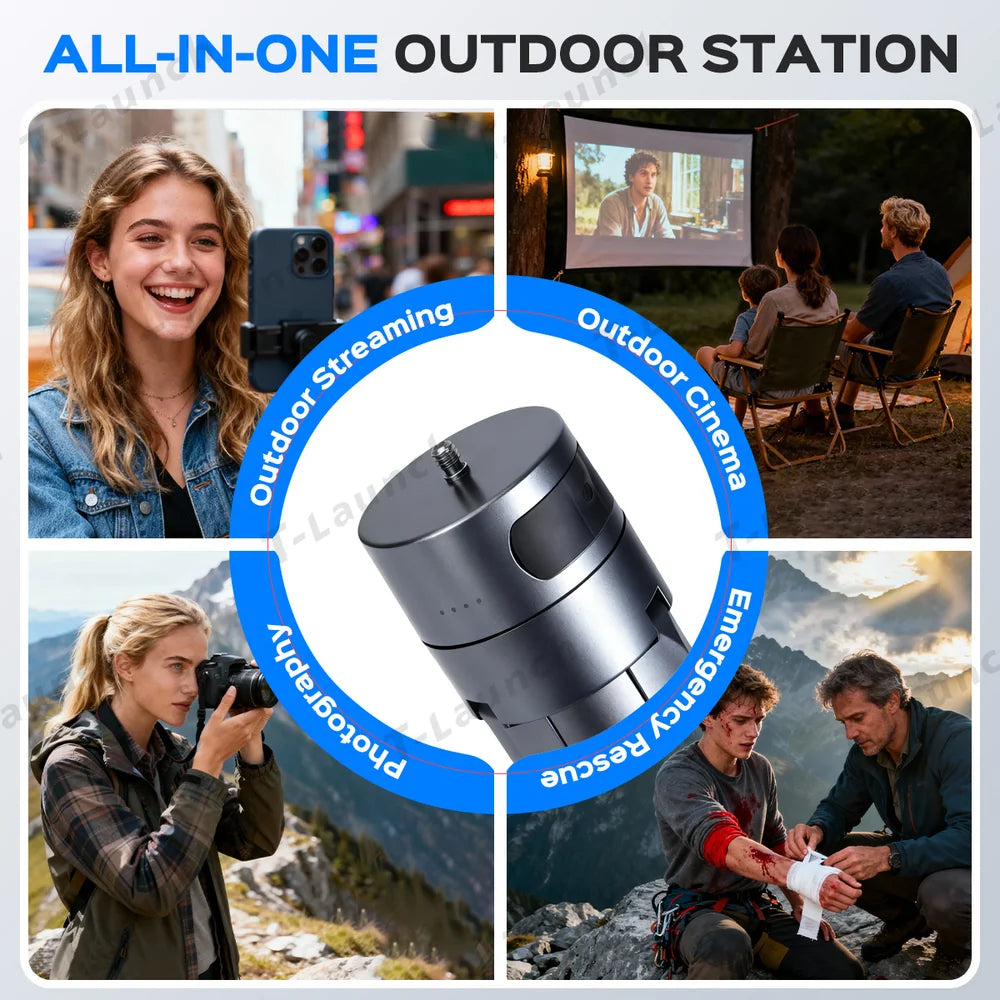
7. Use Cases Where a Battery Stand Makes Sense
A battery stand is most valuable when:
- Camping or overlanding
- Remote work without grid power
- Temporary job sites
- Emergency or backup internet
- Mobile content creation
- Field research or surveys
In these scenarios, setup time and reliability matter more than capacity.
8. When You Don't Need a Battery Stand
A power stand is not mandatory if:
- Starlink Mini stays indoors
- Wall power is always available
- You already use a full power station
- Portability is occasional, not core
This distinction adds neutrality—and builds trust.

9. User Scenarios: What Changes After Adding a Power Stand
Before
- Searching for outlets
- Adjusting cables
- Repositioning constantly
- Short, unpredictable sessions
After
- One-step deployment
- Predictable runtime
- Faster signal lock
- True location flexibility
Most users do not purchase a battery stand until after their first use.
They buy it after the first off-grid experience.
10. Frequently Asked Questions
Is Starlink Mini portable without a battery stand?
Physically, yes, functionally limited.
Without independent power, portability depends on infrastructure.
Can any 100W power bank work?
Not always. Sustained output and PD stability matter more than advertised wattage.
How long can a Starlink Mini battery run?
Typically 4–8 hours depending on capacity, load, and conditions.
Is a tripod essential?
For consistent signal quality, yes—especially outdoors.
11. Conclusion
Starlink Mini is compact and capable—but true portability requires more than smaller hardware.
Without a battery and a stable stand:
- Usage remains power-dependent
- The setup becomes inconsistent
- Off-grid scenarios are compromised
A Starlink Mini Power Stand with Integrated Tripod does not make the device better—it makes it usable everywhere.
For users who rely on Starlink Mini beyond traditional power environments, a battery stand is not an accessory.
It is the component that turns the idea of portability into a reliable reality.